Shelter factor for walls and fences at the Eurocode 1


by Thibaut Frette
Product technical specialist

Abstract

In this article, we will compute the shelter factor that applies to a free-standing wall to account for the presence of an upwind wall or fence.  

Keywords: Advance Design, wall, free-standing wall, Eurocode 1, EN1991-1-4, return corner

1.Introduction

In a previous publication, we have covered the determination of wind forces on a free-standing wall at the Eurocode 1:  

https://civil-engineering-design.com/2022/07/19/wind-action-on-free-standing-walls-at-the-eurocode-1/

The present article goes one step further by considering the interaction between several walls, and the sheltering effect they may produce on each other.

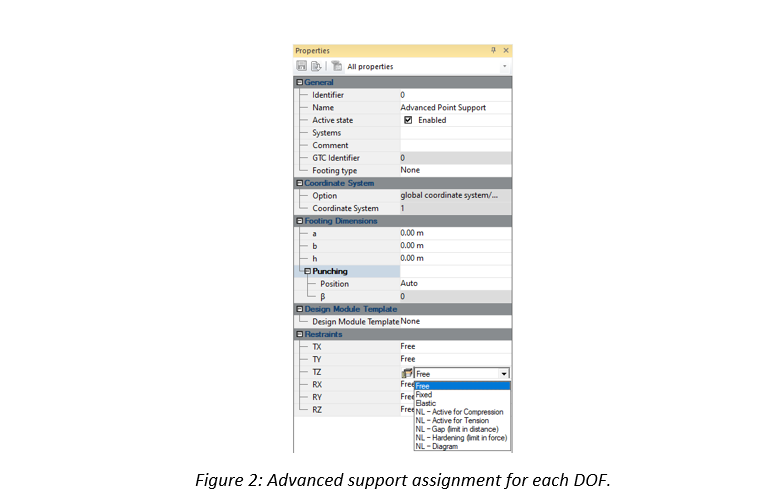
In addition to these supports, a user defined nonlinear support mechanism is also possible (“NL-Diagram” option in Figure 2).

2.    Theory

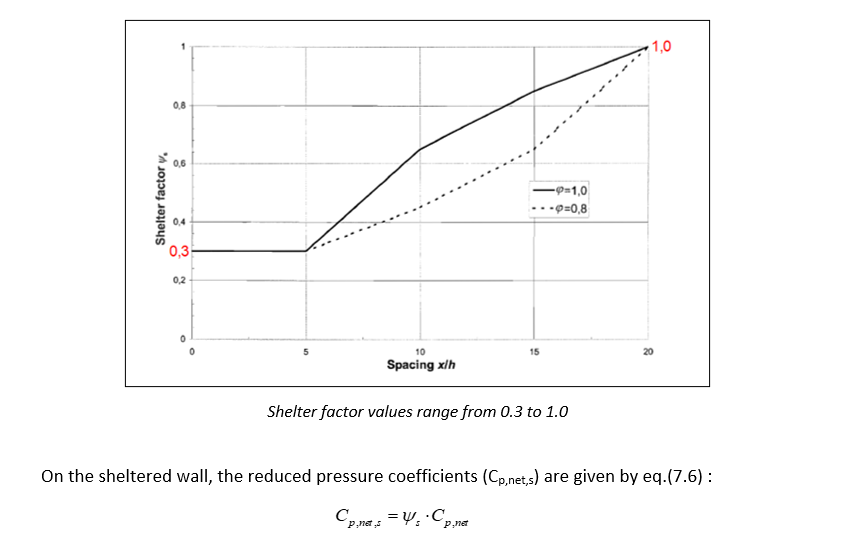
Shelter factor is defined in §7.4.2 from EN1991-1-4.

This coefficient will reduce the pressure coefficients when an upwind wall is able to provide protection to the wall under consideration.

The shelter factor can be determined on Figure 7.20, based on:

  • The spacing between the two walls (x)
  • The solidity ratio of the sheltering wall (φ)
  • The height of the sheltered wall (h)

3. Example

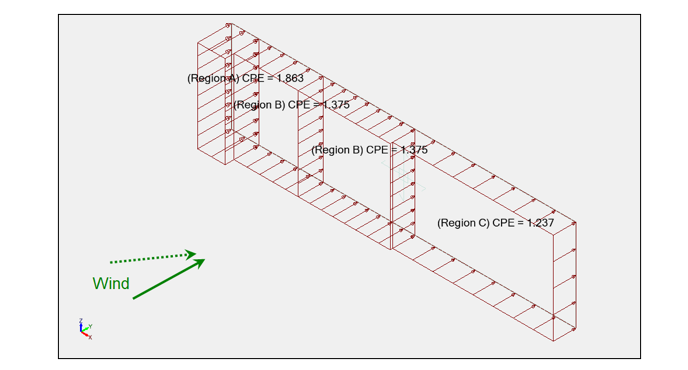
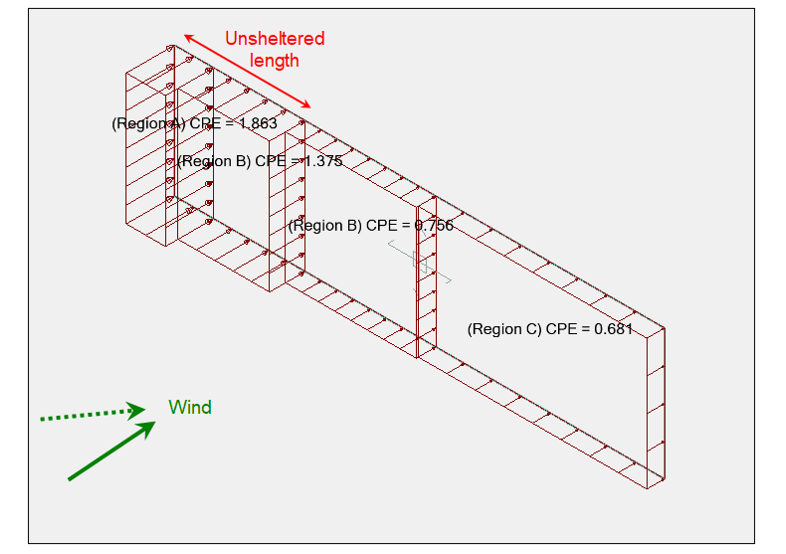
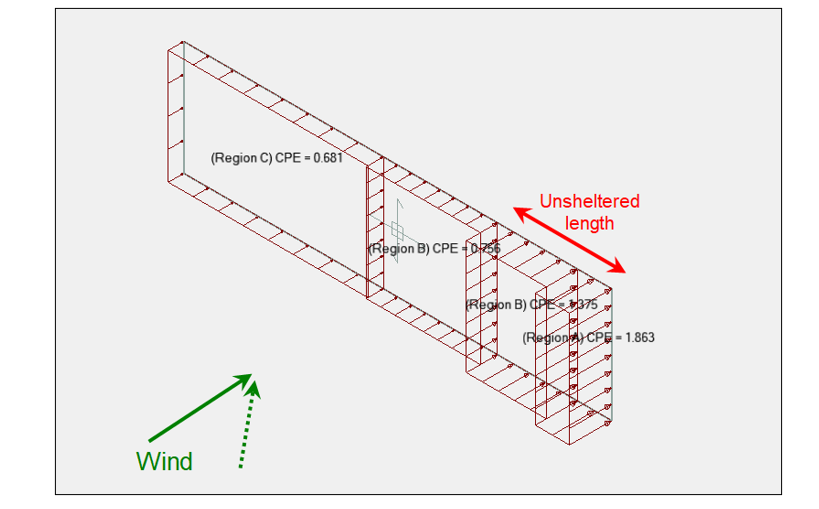
Assume a 15m x 4m wall, with a φ = 0,9 solidity ratio.

The pressure coefficients on this isolated wall would be:

  • Zone A: Cp,net = 1,863
  • Zone B: Cp,net = 1,375
  • Zone C: Cp,net = 1,237

Now, if a similar wall, were to be located at a 40m distance, it would produce a sheltering effect that would be introduced in the calculation through the shelter factor.

Of course, the alternate oblique wind direction should be considered as well:
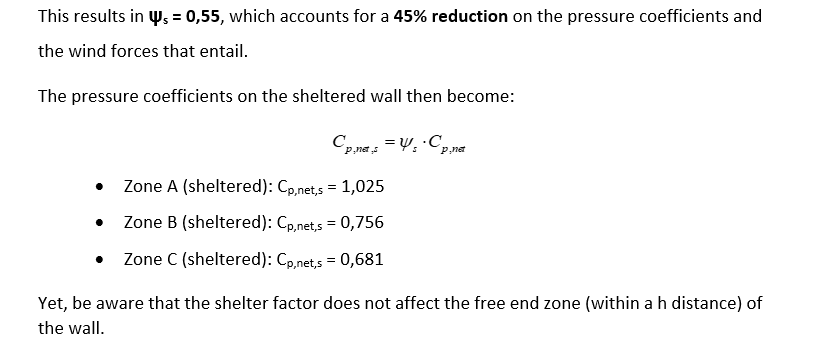
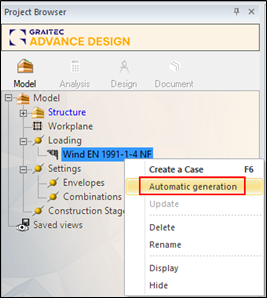
The climatic generator Advance Design is able to automatically detect the potential upwind walls and to compute the corresponding shelter factor for each wind direction. 

On the picture below, Advance Design detected that the wall under consideration could benefit from the sheltering effect of an upwind wall for the Y+ wind direction, resulting in ψs=0,55.
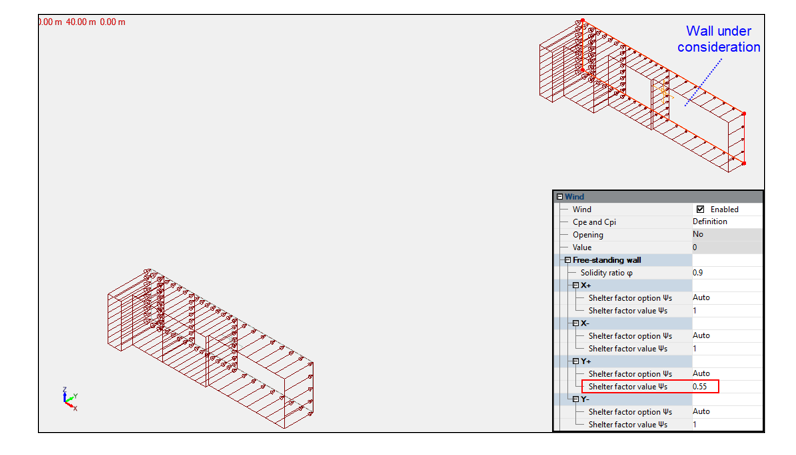
Yet, no such walls were detected in the other directions, resulting in ψs=1,0 for the X+, X- and Y- directions.

4.     Conclusion

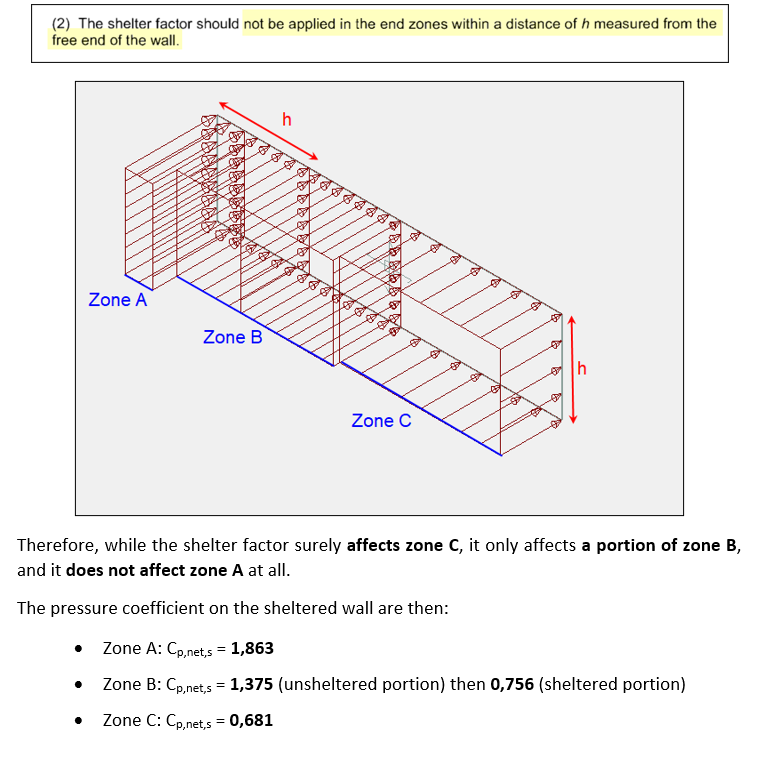
When designing a wall or a fence for climatic actions, the determination of the shelter factor can be a lengthy and tedious process, yet totally worthy as it can allow for a significant reduction of the wind forces.

Fortunately, in Advance Design, the detection of the potential upwind walls with the shelter factor they produce, is performed instantly during the automatic wind generation.
Learn more about Advance Design!

Visit website – https://graitec.com/advance-design/
Visit Advance Design Virtual Stand – https://graitec.com/advance-design-virtual/
Linkedin – https://www.linkedin.com/showcase/advance-design-&-advance-design-connection/
Free trial – https://graitec.com/free-trial/
Application examples of nonlinear advanced supports


by Naim Ayoub
Product technical specialist

Abstract

This article presents application examples of nonlinear advanced supports. The purpose is to highlight how these supports work and the different mechanisms they have.

Keywords: Advance Design, Advanced Supports, Nonlinear Analysis.

1.Introduction

Some structures require special type of supports such as:

  • Supports that work only in tension or compression (tension or compression only supports).
  • Supports that allow displacements/rotations within specified limits. Once these limits are reached, the supports are activated and no further displacements/rotations are allowed (gap supports).
  • Supports that block displacements/rotations until specified reaction forces/moments limits are reached. Once these limits are reached, displacements/rotations are allowed while maintaining the limit forces/moments reactions (hardening supports).

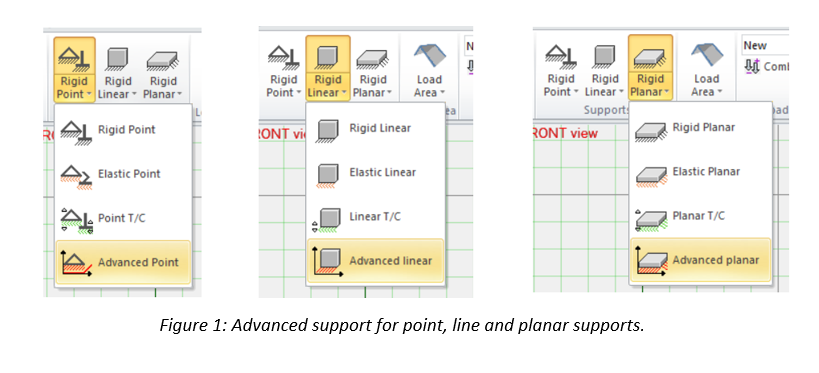
Advance Design has all these special supports available in the advanced supports feature. They can be assigned to each DOF separately and are available for point, line and surface supports (refer to Figures 1 and 2)

In addition to these supports, a user defined nonlinear support mechanism is also possible (“NL-Diagram” option in Figure 2).

2.     Application examples

1.1.            Gap supports

Two identical 2D frame structures are considered. A pin support is used on the left side and an advanced support on the right side for each frame (refer to Figure 3). Frame 2 carries double the load of frame 1.

The advanced support for both frames is fixed in the vertical translation and presents a 2 cm displacement gap in the horizontal translation (refer to Figure 4).

Since nonlinear supports are used, a nonlinear analysis is conducted and the results are presented in Figures 5 and 6:

In Figures 5 and 6, it is clear that for frame 1 the gap support did not reach its limit (1.67 cm < 2 cm) therefore no horizontal support force was applied to block the displacement. For frame 2, theoretically we should get twice the displacement since it carries double the load. However, the gap limit of 2 cm is reached and a horizontal support force is applied to block any further displacement.

2.2.            Hardening supports

Considering similar frame structures to paragraph 2.1. A pin support is used on the left side and an advanced support on the right side for each frame (refer to Figure 7). Frame 2 carries double the load of frame 1.

The advanced support for both frames is fixed in the vertical translation and presents a 10 kN limit hardening support in the horizontal direction (refer to Figure 8).

Since nonlinear supports are used, a nonlinear analysis is conducted and the results are presented in Figures 9 and 10:

In Figures 9 and 10, it is clear that for frame 1 the hardening support limit is not reached (8.27 kN < 10 kN) therefore the support was able to block the displacement. For frame 2, theoretically we should get twice the support force since it carries double the load. However, the hardening support limit of 10 kN is reached and it can no longer block any further displacement requiring more than 10 kN of force.

3.     Conclusion

The advanced supports are a powerful tool in Advance Design for modeling structures with particular support conditions. The user can choose between predefined support mechanisms such as gap and hardening supports or define his own mechanisms.

Learn more about Advance Design!

Visit website – https://graitec.com/advance-design/
Visit Advance Design Virtual Stand – https://graitec.com/advance-design-virtual/
Linkedin – https://www.linkedin.com/showcase/advance-design-&-advance-design-connection/
Free trial – https://graitec.com/free-trial/
Geometry capabilities in Advance Design reinforcement concrete design modules


by Mateusz Budziński
Structural Analysis Product Line Manager

Abstract

 In this article, you will find out what geometry possibilities are available for selected Advance Design reinforced concrete modules – RC Beam, RC Column and RC Footing.

Keywords: Advance Design, Reinforcement, Beam, Column, Foundation, Geometry

Introduction

One of the characteristics of good and universal design software is flexibility in the range of supported geometry types. Indeed, what if our software allows a full range of analysis, if it supports only one or two basic geometric types. Therefore, Advance Design reinforced concrete element design modules offer a wide range of geometry types and a large range of their modifications. Let us take a look at the capabilities of 3 of the modules in this regard: RC Column, RC Beam and RC Footing.

RC Column

Advance Design RC Column module allows you to perform reinforcement analysis of reinforced concrete columns. One of the basic geometric settings is the selection of the column section. There are eight types to choose from:

It should be noted that the type and distribution of reinforcement in the elements shown in the above and next images are only examples, as in practice they depend on many factors (starting from the load, through the individual settings of reinforcement parameters, to the standard conditions for the given country).

In the case of RC columns, it is also worth mentioning the possibility of specifying the beams and columns above, which affects the configuration of the starting bars.

RC Beam

Advance Design RC Beam module allows you to perform reinforcement analysis of reinforced concrete beams. Apart from the possibility of defining a beam as a multi-span beam, the main geometry modification possibilities concern the cross-section as well as openings and depressions.

Let us start with the cross-section of a typical beam – a simple cast-in-place rectangular section.

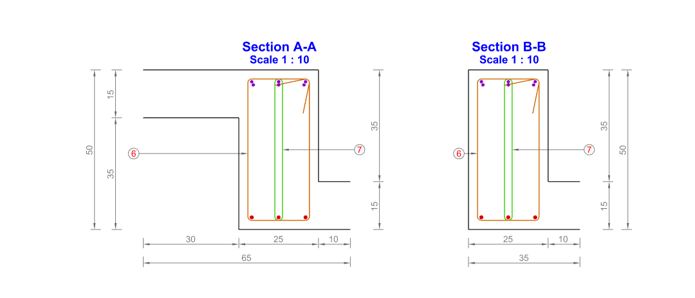
The next types of configurations available are cross sections in which part of the section is prefabricated. We can define different types of configurations with prefabricated beams, slabs, and cuts.

There are also various possibilities for modifying the beam’s elevation, including the possibility of defining lower and upper depressions on any part of the span, as well as defining rectangular and circular openings.

As with all other types of geometry, even for such an unusual beam as in the image above, the reinforcement is calculated automatically, taking into account all standard requirements.

In addition, the RC Beam module enables the definition and analysis of corbels, which can have fixed or variable heights.

RC Footing

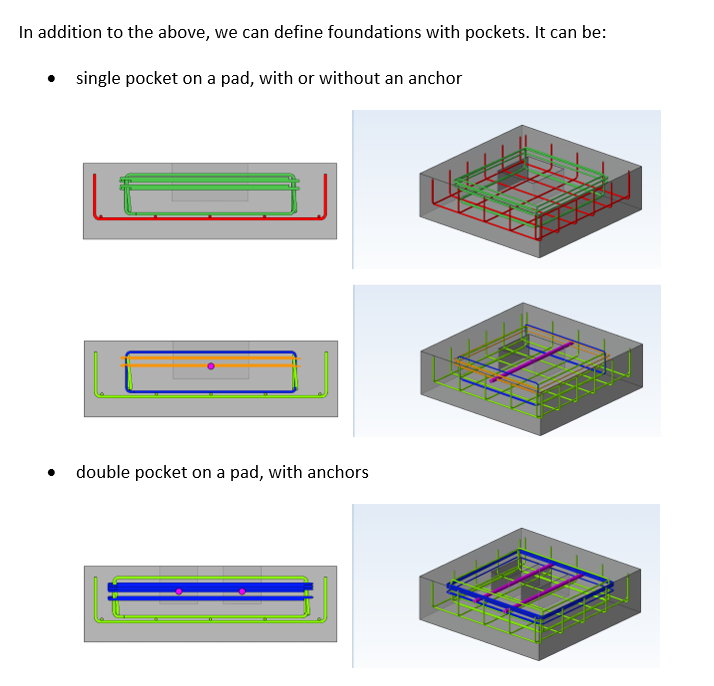
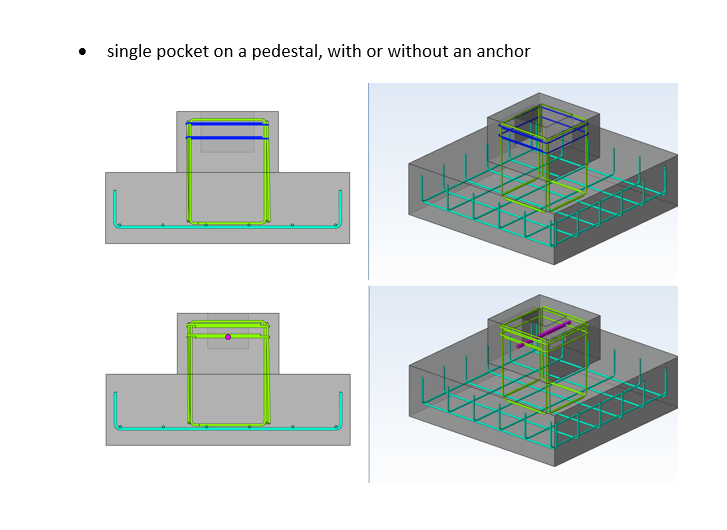
Advance Design RC Footing module allows you to perform reinforcement and geotechnical analysis of concrete isolated and continuous footings.

The basic possibilities of modification for continuous foundations are the ability to specify bevels, i.e. the possibility of obtaining a trapezoidal cross-sectional shape. In addition, we can freely modify the position of the supporting element (wall).

Finally, it is worth mentioning that in addition to modules for RC beams, columns and foundations, Advance Design also includes other design modules, including reinforced concrete walls and shear walls, which allow many types of geometry. But that’s a topic for a separate story.

Learn more about Advance Design!

Visit website – https://graitec.com/advance-design/
Visit Advance Design Virtual Stand – https://graitec.com/advance-design-virtual/
Linkedin – https://www.linkedin.com/showcase/advance-design-&-advance-design-connection/
Free trial – https://graitec.com/free-trial/